In the previous article ( article link ), we explored how Large Language Models (LLMs) work internally, from tokenisation and embeddings to transformers and next-token prediction. If you haven't read that article yet, I would recommend going through it first, as many of the concepts discussed here build on that foundation.
One of the most important ideas we learned is that an LLM generates text by predicting the next most likely token based on everything it has seen so far. Through training on enormous amounts of data, the model learns patterns in language, facts, reasoning structures, coding syntax, and much more.
This approach is surprisingly powerful. It allows LLMs to answer questions, explain concepts, write code, summarize documents, and even perform multi-step reasoning through techniques such as Chain of Thought.
However, despite all these capabilities, LLMs have an important limitation.
They only generate text.
At first, this might not sound like a major problem. But consider a few simple questions:
- What is the weather in Pune right now?
- What is the current stock price of Apple?
- Send an email to my manager.
- Calculate the square root of a very large number.
- Search through a company's internal documentation and find a specific policy.
A traditional LLM struggles with these tasks for different reasons.
For example, weather information changes every minute, but an LLM is trained on historical data. It cannot magically know what happened after its training cutoff.
Similarly, when performing calculations, the model is not actually using a calculator. It is generating what it believes is the most likely sequence of tokens. While this often produces correct answers for simple arithmetic, it can become unreliable for more complex calculations.
Even reasoning can fail. If the model makes an incorrect assumption early in a Chain of Thought process, every reasoning step that follows may also become incorrect. A small mistake at the beginning can propagate through the entire chain.
The fundamental issue is that the model has no way to verify its answers against the real world. What if we could allow an LLM to interact with the outside world instead of relying entirely on its internal knowledge? What if it could search the web, use a calculator, query a database, read files, call APIs, and then use the results to continue its reasoning?
This simple idea led to one of the most important developments in modern AI systems: Agentic AI.
Before ReAct: Two Separate Worlds
Before the ReAct paper, researchers mainly explored two different approaches for improving LLMs.
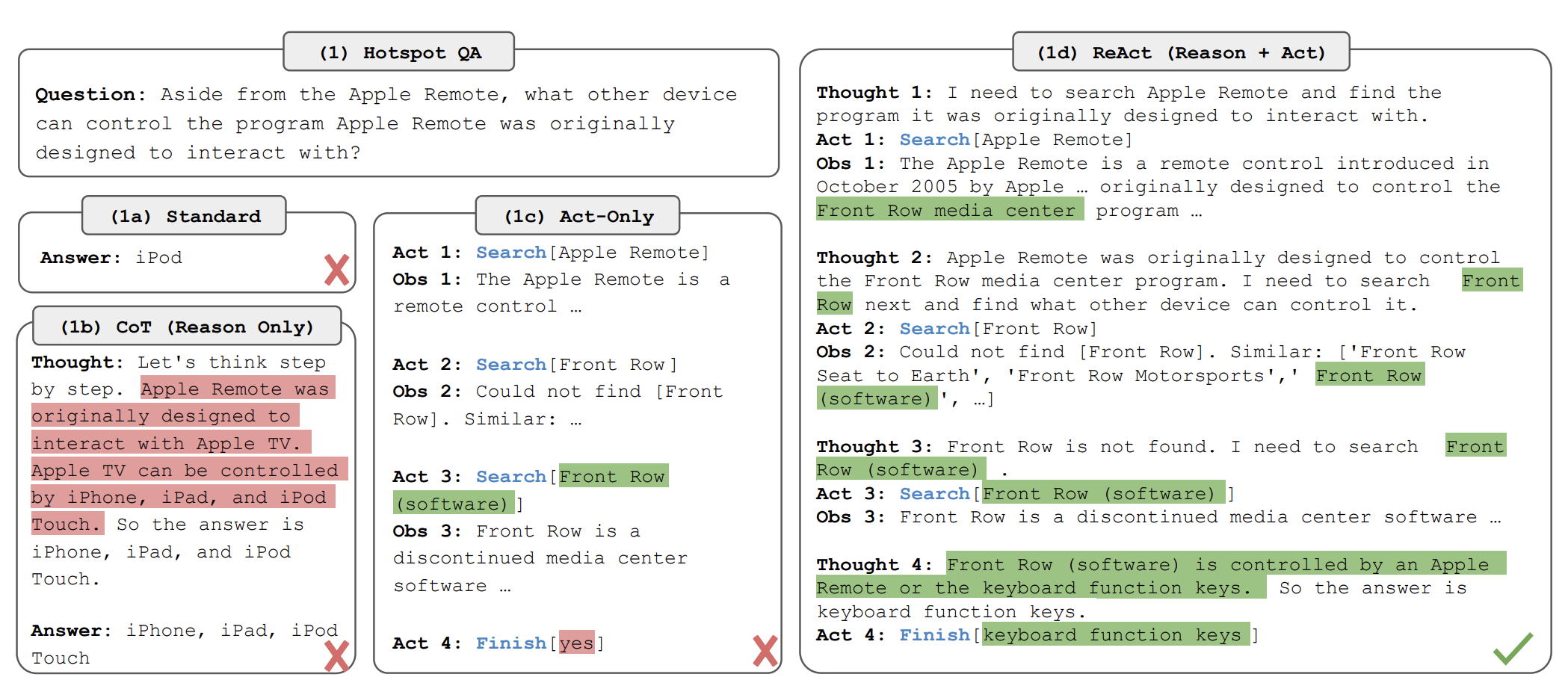
1. Chain of Thought (Reasoning Only)
The first approach was Chain of Thought (CoT). The model was encouraged to reason step by step before producing an answer.
Thought:
Reasoning...
Reasoning...
Reasoning...

Answer
2. Tool Usage (Action Only)
Another line of research focused on giving models access to external tools such as search engines, databases, or APIs.
Search(...)
Search(...)
Search(...)

Answer
The Core Idea Behind ReAct
The authors of the ReAct paper asked a simple question: Why not combine reasoning and acting?
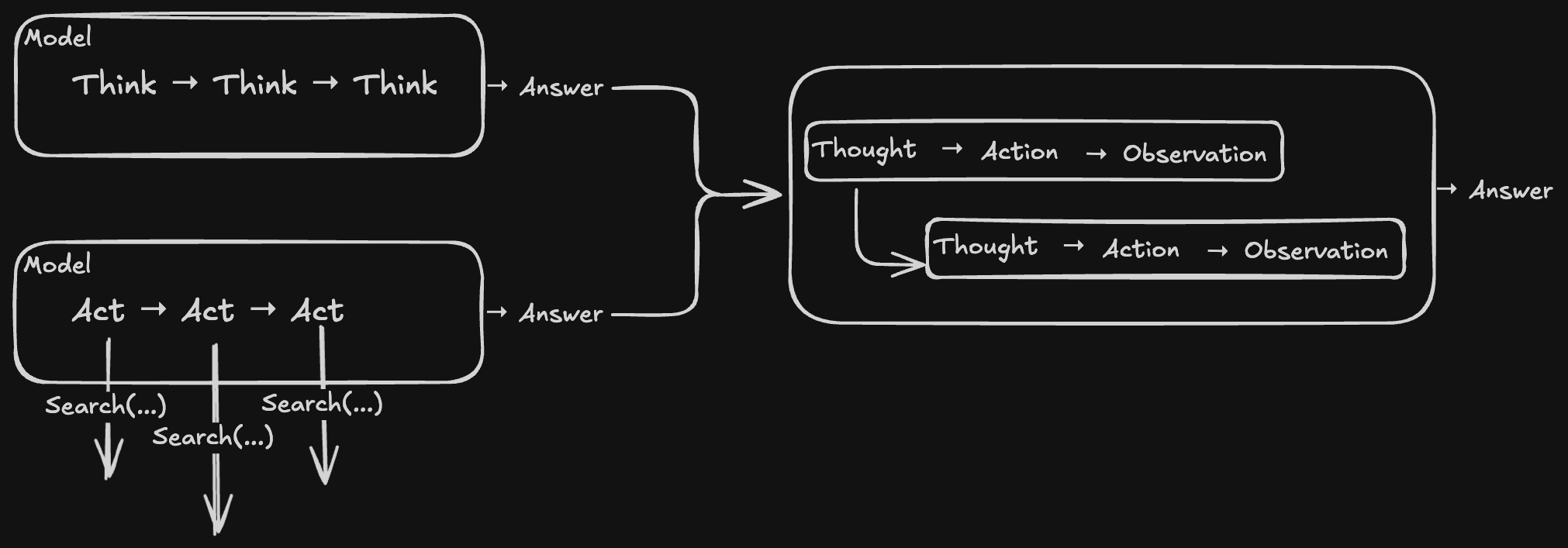
This became the ReAct framework:
Reason → Act → Observe → Reason → Act → Observe
By allowing the model to alternate between thinking and interacting with the outside world, it could use external information to guide its reasoning and use reasoning to guide its actions.
This simple idea became one of the foundations of modern AI agents.
Interestingly, this pattern is not completely foreign to us. Humans often solve problems in a very similar way.
Imagine you are trying to buy a new laptop.
You typically don't sit in a room and reason entirely from memory until you reach a decision. Instead, your thinking process looks something like this:
Thought:

I need a laptop for software development.

Action:

Search for laptops.

Observation:

I find several options.

Thought:

The MacBook looks interesting, but it is expensive.

Action:

Read reviews and benchmarks.

Observation:

The battery life and performance are excellent.

Thought:

Let me compare it with other options.

Action:

Search for alternatives.

Observation:

I find a few Windows laptops with similar specifications.

Thought:

After comparing the trade-offs, I prefer the MacBook.

Answer:

Buy the MacBook.
Notice what happened.
The decision was not produced through reasoning alone, nor was it produced by blindly collecting information. Instead, reasoning guided what information to gather, and new information continuously updated the reasoning process.
Humans naturally operate in a loop of thinking, acting, observing, and thinking again.
In many ways, ReAct brings a similar pattern to language models. Instead of forcing the model to rely entirely on its memory or blindly use tools without a plan, it allows the model to continuously combine reasoning with interaction.
This is what makes ReAct feel intuitive. It is not just giving an LLM access to tools; it is giving the model a structured way to use those tools while continuously updating its understanding of the problem.
Teaching LLMs to Reason and Act
At this point, an interesting question appears:
How did researchers actually teach a language model to follow the ReAct pattern?
Did they train a completely new model?
Did they modify the transformer architecture?
Surprisingly, the answer was no.
As we discussed in the previous article, prompting can significantly influence the behavior of an LLM. We can guide the model toward a specific style of reasoning simply by providing examples in the prompt.
The ReAct paper used this same idea.
Instead of training a new model from scratch, the researchers showed the model a few examples that followed a specific format:
Question: ...

Thought: ...

Action: Search(...)

Observation: ...

Thought: ...

Action: Search(...)

Observation: ...

Answer: ...
This is an example of Few-Shot Prompting.
By providing several demonstrations of how a problem should be solved, the model learns the pattern and continues it for new questions.
In other words, the model was not explicitly programmed to reason and act. It was shown examples of reasoning and acting together, and it learned to imitate that behavior.
To understand this better, let's look at a project I built: NL2SQL.
Project Link: https://adeshghadage.github.io/portfolio/projects/NL2SQL.html
The goal of the project is simple. A user uploads a CSV or Excel file and asks questions in natural language, such as "Show me the top 10 customers by revenue" or "Which product category generated the highest sales last month?" The system then analyzes the data and returns results, summaries, and visualizations.
At first glance, it might seem like the LLM is doing everything. However, the architecture diagram below tells a different story.
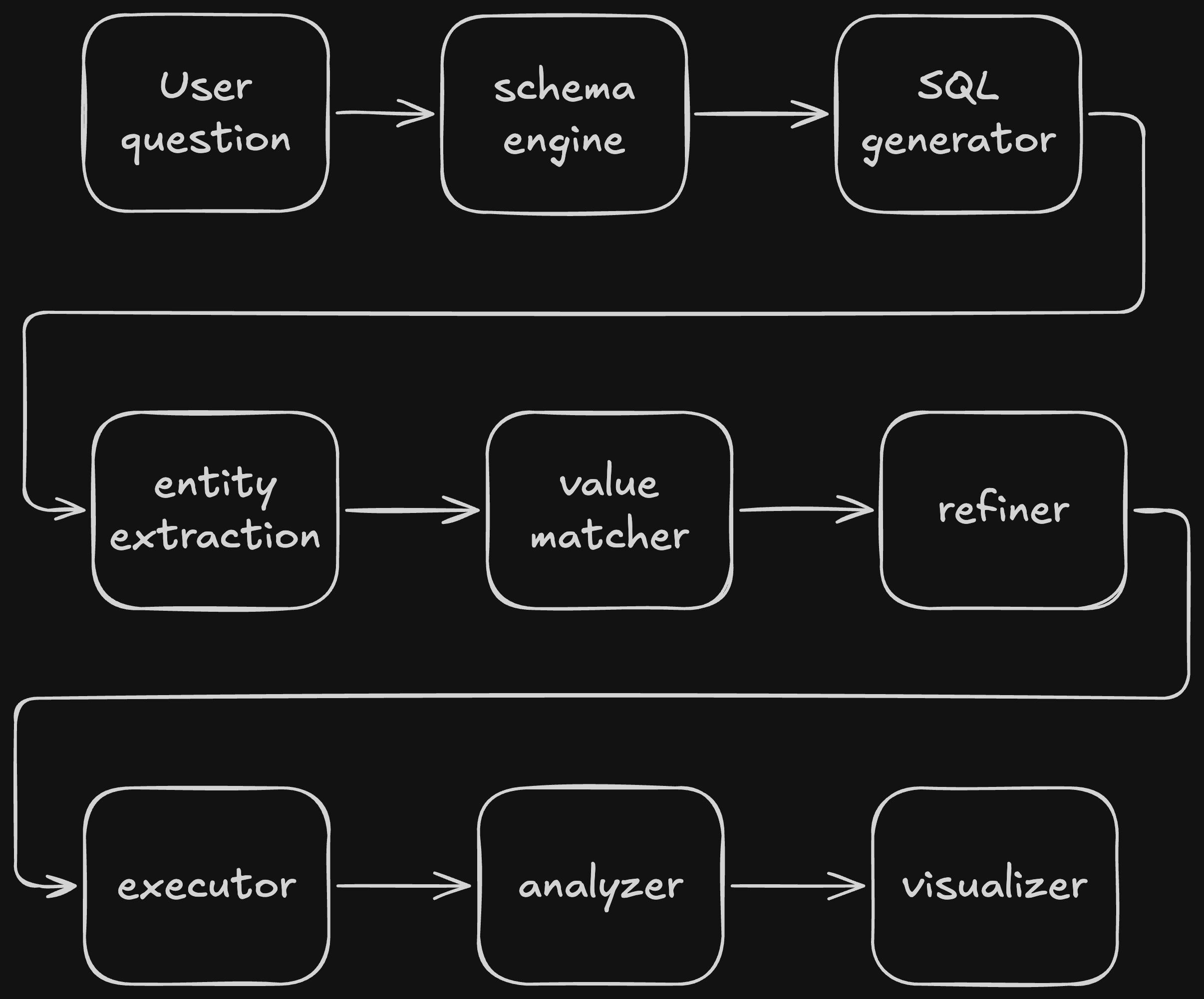
The first thing that happens is that the application reads the uploaded file and extracts information about its structure. The schema engine identifies tables, column names, data types, and sample values. This information is important because the LLM has never seen the user's data before. Without understanding the schema, it would have no idea what tables or columns exist.
Once the schema is extracted, the application sends the user's question together with the schema information to the LLM. The model's job is not to answer the question directly. Instead, it reasons about the problem and generates a SQL query that should retrieve the required information.
At this point, the LLM's work is essentially finished.
The model does not execute the SQL query. It does not connect to the database. It does not validate whether the query is correct. It does not generate charts. It does not inspect the returned results. All of those responsibilities belong to the surrounding application.
The application takes the generated SQL and executes it against the database. If the query fails, references the wrong column, or produces poor results, the system can refine the query and try again. Once valid results are obtained, other components generate visualizations, summaries, and insights before returning the final response to the user.
This architecture taught me an important lesson about modern Agentic AI systems.
The intelligence is not coming from the language model alone. The intelligence emerges from the collaboration between the LLM and the software around it.
The application keeps track of the workflow, maintains state, stores data, validates outputs, manages retries, and executes actions. The LLM is primarily responsible for reasoning. It receives context, analyses the problem, and decides what should happen next.
In many ways, this follows the same idea introduced by ReAct. The model reasons about the task, the application performs actions in the real world, observations are collected, and those observations can be fed back into the system for further reasoning. Rather than relying entirely on the model's memory, the system continuously interacts with external data and tools.
This separation between reasoning and execution is one of the key ideas behind modern Agentic AI. The LLM acts as the brain, while the surrounding application acts as the hands, eyes, memory, and infrastructure that allow the system to interact with the real world.
Final Thoughts
When I first started learning about AI agents, I assumed they were powered by some completely new type of model. After digging deeper, I realised that most modern Agentic AI systems are still built on the same foundation: Large Language Models predicting the next token.
The difference is not necessarily a new model. The difference is how we use the model.
By combining reasoning, external tools, memory, and software workflows, we can build systems that are far more capable than a standalone LLM. The ReAct paper showed that reasoning and acting do not need to be separate capabilities. A model can think, interact with the outside world, observe the results, and continue reasoning based on what it learns.
Building my NL2SQL project helped me understand this idea much more clearly. The LLM was not executing SQL queries, reading databases, creating charts, or managing application state. It was primarily responsible for reasoning. Everything else was handled by the surrounding software system. This separation between reasoning and execution is one of the most important ideas behind modern Agentic AI.
In many ways, AI agents are less about creating a smarter model and more about creating better systems around the model. The LLM provides the reasoning, while the application provides tools, memory, validation, and the ability to interact with the real world.
As AI systems continue to evolve, I think understanding this distinction is important. The future may not belong to models alone, but to systems that can effectively combine reasoning, actions, observations, and external knowledge into a continuous feedback loop.
And interestingly, that loop looks surprisingly similar to how humans solve problems every day: think, act, observe, learn, and think again.